Jet-powered Shahed (Geran-3, Geran-4, Shahed-238)
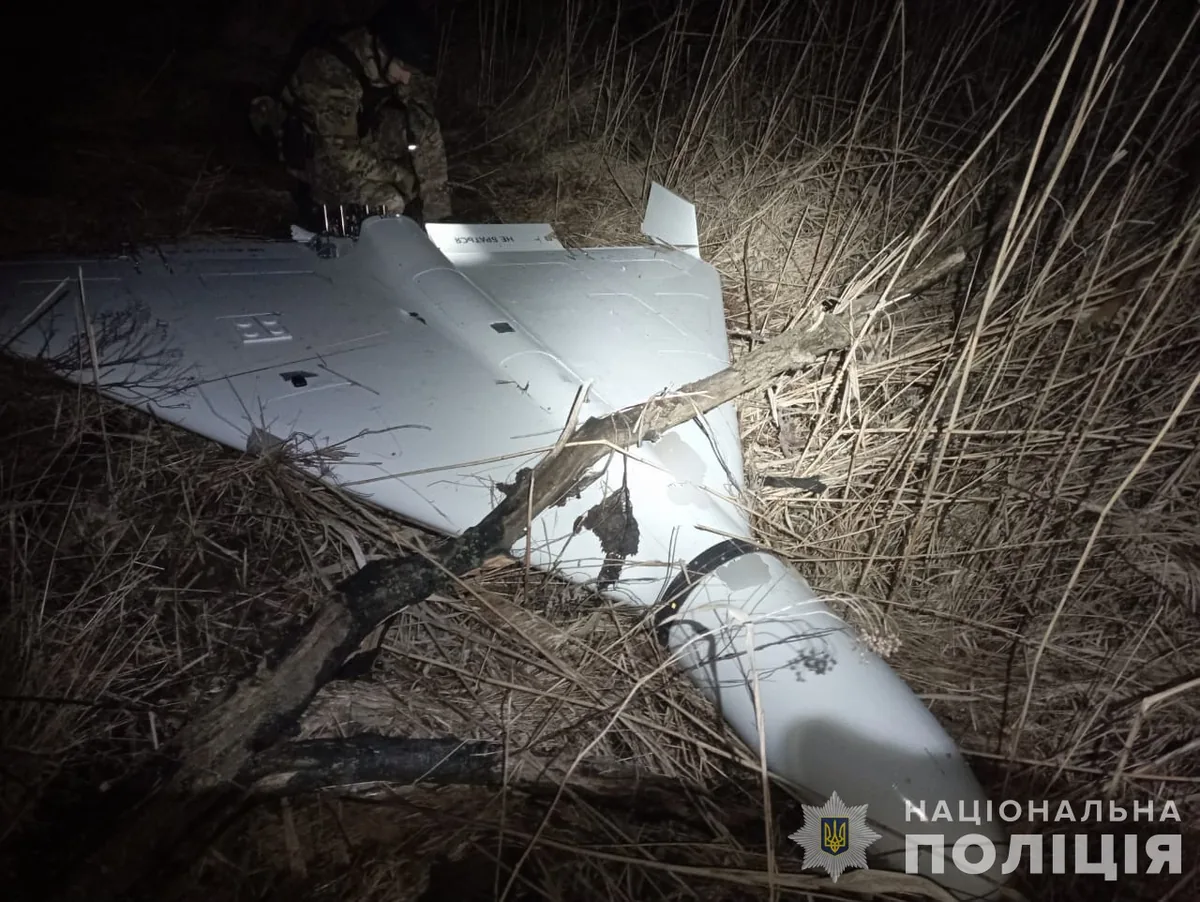
The jet-powered Shahed is a one-way attack drone with a turbojet instead of a propeller. The first was the Geran-3 — Russia's version of the Iranian Shahed-238; in 2026 it was replaced by the Geran-4, with a reinforced airframe and a speed of up to 500 km/h. By our measurements jet drones fly to their target at an average of 340 km/h — about twice as fast as a regular Shahed. From Bryansk Oblast to Kyiv that is about 38 min.
Jet-powered Shahed speed: claimed and measured
Claimed figures vary by model. The Iranian Shahed-238 was credited with 550–600 km/h; the first Russian Geran-3, on the old airframe, held about 300 km/h; the new Geran-4 flies at 400–550 km/h [2] [3]. But the drone holds its top speed only briefly: the turbine burns fuel fast, so it speeds up mainly near air-defence zones and in the final dive. We computed the average speed to impact over 541 real arrivals on the map — 340 km/h (≈ 94 m/s). That is the speed the map uses for the time to arrival.
Ukraine's Air Force expects future versions to reach 800–900 km/h; none has been recorded yet [2].
How long a jet-powered Shahed takes to reach Kyiv, Kharkiv, Dnipro, Odesa and Lviv
The times below are straight-line from the launch site to the city centre, at the measured speeds: 340 km/h for the jet drone and 140 km/h for the regular one. They are a lower bound: drones rarely fly straight — they go around air defence, change course and come in from another side. For a specific target the map counts from its current position, not from the launch site.
jet-powered Shahed regular Shahed
| From | Kyiv | Kharkiv | Dnipro | Odesa | Lviv |
|---|---|---|---|---|---|
| Bryansk Oblast (Churovichi) | 38 min 1 h 35 min 217 km | 1 h 5 min 2 h 45 min 382 km | 1 h 20 min 3 h 20 min 465 km | 1 h 55 min 4 h 35 min 639 km | 1 h 50 min 4 h 25 min 615 km |
| Kursk | 1 h 15 min 3 h 420 km | 34 min 1 h 25 min 193 km | 1 h 5 min 2 h 40 min 372 km | 2 h 5 min 5 h 5 min 706 km | 2 h 35 min 6 h 15 min 879 km |
| Oryol | 1 h 25 min 3 h 25 min 473 km | 58 min 2 h 20 min 331 km | 1 h 30 min 3 h 35 min 506 km | 2 h 25 min 5 h 50 min 817 km | 2 h 40 min 6 h 25 min 903 km |
| Shatalovo | 1 h 20 min 3 h 15 min 452 km | 1 h 35 min 3 h 55 min 547 km | 2 h 4 h 50 min 677 km | 2 h 35 min 6 h 20 min 882 km | 2 h 15 min 5 h 25 min 763 km |
| Millerovo | 2 h 5 min 5 h 10 min 722 km | 56 min 2 h 15 min 316 km | 1 h 10 min 2 h 45 min 389 km | 2 h 15 min 5 h 30 min 767 km | — |
| Primorsko-Akhtarsk | 2 h 10 min 5 h 20 min 748 km | 1 h 20 min 3 h 20 min 462 km | 1 h 5 min 2 h 35 min 357 km | 1 h 40 min 4 h 5 min 574 km | — |
| Chauda (Crimea) | 2 h 10 min 5 h 10 min 724 km | 1 h 40 min 4 h 556 km | 1 h 10 min 2 h 45 min 390 km | 1 h 15 min 3 h 5 min 430 km | — |
| Hvardiiske (Crimea) | 1 h 55 min 4 h 35 min 647 km | 1 h 40 min 4 h 5 min 568 km | 1 h 5 min 2 h 45 min 381 km | 52 min 2 h 5 min 294 km | 2 h 40 min 6 h 30 min 912 km |
Launch sites are the directions Ukraine's Air Force names for strike drones in general; it does not publish them for jet drones separately. "—" means more than 1000 km, the longest claimed range of the jet Gerans.
Specifications of the Geran-3 and Geran-4
| Type | one-way attack drone (kamikaze drone) with a turbojet engine |
|---|---|
| Other names | Shahed-238 (Iranian), Geran-3 and Geran-4 (Russian «Герань»), "jet Shahed" |
| Engine | Geran-3 — Chinese Telefly JT80 [1]; Geran-4 — Chinese Telefly TF-TJ2000A [2] |
| Speed | Geran-4 — up to 500 km/h [2], 400–550 km/h by expert estimates [3]; our measurement — 340 km/h to impact; per Defence Intelligence (October 2026) — cruise 320 km/h, maximum 450 [23] |
| Range | Geran-4 — 450–600 km depending on the warhead [2]; Geran-3 — up to 1,000 km according to Defence Intelligence [1]; per Defence Intelligence — Geran-4 770 km, Geran-5 950 km [23] [24] |
| Warhead | up to 50 kg; up to 90 kg in the thermobaric version [2]; per Defence Intelligence — 90 kg (TBBCh-50, ZBBCh-50 + OFBCh-2, TBBCh-90) in both the Geran-4 and the Geran-5 [23] [24] |
| Take-off weight | Shahed-238 — about 370 kg, 250 kg by other data [4] |
| Price | from $100,000 to $170,000–200,000 per drone; the engine alone — $30,000–35,000 [2] |
| Altitude | 4–7 km [2] [3] |
| Size | length ~3.5 m, wingspan ~3 m [2] |
| Guidance | a pre-set route by satellite navigation; on the final leg the Geran-4 can be steered by an operator through a video camera [2] [3] |
| Share of Shaheds | about 40 % of strike drones since July 2026; the Air Force expects up to 80 % [2] |
| First use | debris resembling the Shahed-238 — January 2024; first documented use — June 2025, an attack on Kyiv [7] |
| Geran-4 per Defence Intelligence | length 3.6 m, wingspan 3.05 m, take-off weight up to 450 kg, 2.2 h endurance, ceiling 4 km; navigation — SADRA inertial unit, Susanin optical correlation system and a Unicore UC9810 GNSS module [23] |
| Geran-5 per Defence Intelligence | length 6.5 m, wingspan 3.2 m, take-off weight 850 kg, up to 2 h endurance, ceiling 6,000 m, Telefly TF-TJ2000A engine, Kometa-M12 and MINSOO V3 navigation [24] |
The most valuable figure in the Defence Intelligence catalogue is the Geran-4's cruise speed of 320 km/h: our measurement over 541 real arrivals gave 340 — the map counts almost exactly what the documentation says. Components: the Geran-4 holds 74 parts from seven countries (Micron, STMicroelectronics, Texas Instruments, Analog Devices, Infineon, TDK, Murata, Toshiba, U-blox, Unicore; its GNSS module was made in December 2025), the Geran-3 45 from six (Telefly JT80, a Bosch fuel pump, Raspberry Pi, U-blox), the Geran-5 only 16 from three — China, Germany and the United States [23] [24].
Geran-3, Geran-4 and Geran-5: the difference
All three are jet-powered strike drones, but they are different machines. The Geran-3 and Geran-4 are a Shahed with a turbine instead of a propeller; the Geran-5 is a different, aircraft-like design closer to a cruise missile.
| Geran-3 | Geran-4 | Geran-5 | |
|---|---|---|---|
| Design | Shahed airframe with a turbine | reinforced Shahed airframe | aircraft-like, resembles the Iranian Karrar |
| Speed | ~300 km/h | 320 cruise / 450 max (Defence Intelligence); 400–550 by experts | 450–600 km/h (cruise) |
| Range | up to 1,000 km | 770 km (Defence Intelligence); 450–600 by other sources | up to 950 km |
| Engine | Telefly JT80 | Telefly TF-TJ2000A | Telefly TF-TJ2000A |
| Take-off weight | — | — | 850 kg |
| Status | production wound down | the main jet drone since 2026 | since January 2026, fewer in number |
Sources: Defence Intelligence [1] [11], 24 Kanal [2], NV [3]. The Geran-3 and Geran-4 figures come from open estimates and differ between sources.
Does the jet-powered Shahed have a camera?
Yes, the Geran-4 does. Unlike older Shaheds, which flew only along a pre-set route, some jet drones are steered by an operator through a video camera on the final leg: the operator locks onto the target 3–5 km out, and the drone attacks on its own from there [2] [3]. That is why GPS jamming has almost no effect on the final approach.
What a jet-powered Shahed sounds like
Not the familiar "moped" rattle of a regular Shahed but an even roar or whistle of a turbine — closer to an aircraft, and louder [6]. Before the strike the drone climbs and accelerates to ~500 km/h, so the sound builds quickly [5]. Do not rely on sound: at 4–7 km it may be barely audible until the dive.
How the jet-powered Shahed differs from the regular one
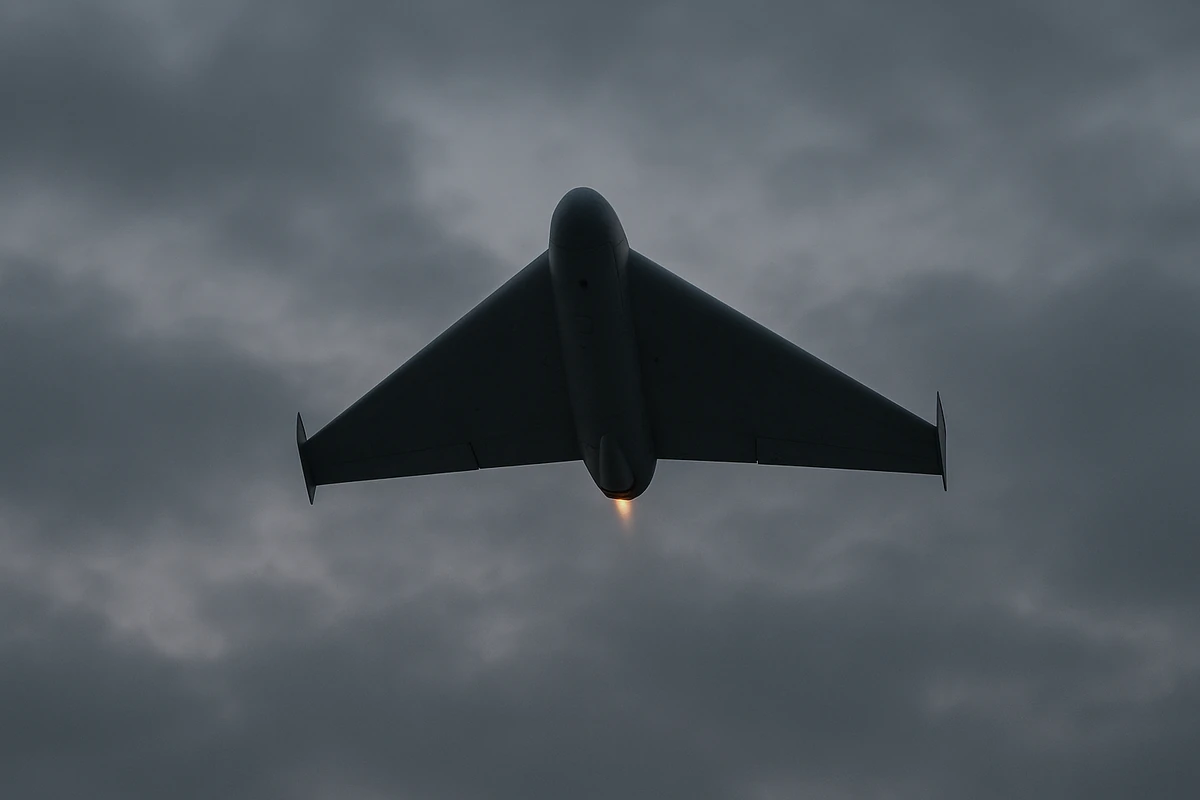
- Engine. A turbojet with a nozzle at the tail instead of a piston engine with a propeller.
- Speed. About twice as high: 340 vs 140 km/h by our measurements. It covers the same distance twice as fast — and leaves half as much time to take shelter.
- Altitude. It flies at 4–7 km — higher than the machine guns of mobile fire teams can reach [2].
- Reaction time for air defence. About 12 seconds instead of roughly 60 for a regular Shahed [3].
- Sound. A turbine roar instead of the "moped" rattle — more.
- Warhead. Smaller: the turbine needs more fuel [2] [5].
- On the map. Different markers and colours: jet-powered — with a nozzle, regular — .
How jet-powered Shaheds are shot down
Mainly by surface-to-air missile systems and aircraft [3]. MANPADS sometimes down jet drones, but these often fly too high; above 3.5 km, mobile fire teams, Gepard anti-aircraft guns and some MANPADS are practically useless [2]. Hence the bet on interceptor drones: they first downed jet Shaheds on the night of 30 November 2025 [4], and in September 2026 new, faster interceptors appeared — on 19 September one of them was used by SBU military counter-intelligence to destroy a jet Shahed [8]. The problem is cost: an interceptor missile costs $50,000–150,000 [3], an interception by a drone about $2,500 [2]. Experts aim for a 90–98 % kill rate, as against regular Shaheds [3].
For anyone waiting for the alert, what matters more: a jet drone leaves less time. From Bryansk Oblast to Kyiv it flies 38 min, a regular one 1 h 35 min.
What changed in 2026
- Russia moved from the Geran-3 on the old airframe to the Geran-4 — reinforced airframe, faster manoeuvres, shorter range [2] [3].
- Some drones are guided to the target by an operator through a camera, not only along a route [2].
- There are more jet drones: about 40 % of strike drones since July, with plans for up to 80 % [2].
- On 1 October Serhii Beskrestnov ("Flash") showed Shaheds with two "whiskers" on the fuselage; their purpose is not yet known — "they are definitely not antennas" [9].
Where they are launched from
Every night Ukraine's Air Force names the directions strike drones were launched from: Bryansk, Kursk, Oryol, Shatalovo, Millerovo, Primorsko-Akhtarsk, and in Crimea — Chauda and Hvardiiske [10]. Launch sites for jet drones are not published separately, so the table above uses the same ones as for all Shaheds.
What a jet-powered Shahed looks like on the map
An orange marker with a nozzle — "Jet Shahed". Next to it, how many minutes are left until it arrives; the dashed line shows where it is heading. Open the map · what is in the air now · how we compute the time to arrival · all threat types · the regular Shahed · Gerbera decoys
Sources
- Defence Intelligence of Ukraine — Geran-3, components catalogue
- 24 Kanal — Geran-4: specifications of the jet drone and how it is shot down (06.10.2026, in Ukrainian)
- NV — why jet Shaheds are hard to shoot down: experts (12.09.2026, in Ukrainian)
- Militarnyi — an interceptor drone downs a jet Shahed for the first time (in Ukrainian)
- Dengi — the real speed of jet Shaheds, explained by an officer (in Ukrainian)
- Fakty — what a jet Shahed is and why it is dangerous (in Ukrainian)
- The Page — first use of the Geran-3 in an attack on Kyiv (in Ukrainian)
- ArmyInform — jet Shahed destroyed by a new interceptor drone (19.09.2026, in Ukrainian)
- Glavcom — Flash shows Shaheds with unusual "whiskers" (01.10.2026, in Ukrainian)
- ArmyInform — Air Force summary: launch directions of strike drones (in Ukrainian)
- ArmyInform — Defence Intelligence on the Geran-5 (19.01.2026, in Ukrainian)
- Defence Intelligence of Ukraine, War & Sanctions — Geran-4 UAV (October 2026): specifications, components and manufacturers
- Defence Intelligence of Ukraine, War & Sanctions — Geran-5 UAV: specifications, components and manufacturers
Our figures — the 340 km/h speed and the flight times — come from the Alarm Maps map; how we compute them is described on the Sources page.
Updated .