Kinzhal (Kh-47M2): how long it takes to reach Kyiv
The Kinzhal (Kh-47M2) is an aeroballistic missile based on the Iskander, launched from a MiG-31K fighter. From a launch over Lipetsk Oblast to Kyiv it flies between 3.1 min and 8.2 min: the first figure assumes the speed Russia claims, the second an independent estimate of the real one. In 2026 Kinzhals have become rare: according to Ukraine's Defence Intelligence, serial production was halted in April [5].

How long the Kinzhal takes to reach Kyiv, Kharkiv, Dnipro, Odesa and Lviv
Russia claims up to Mach 10 for the Kinzhal; independent estimates of its real speed are about Mach 4 after launch and Mach 3–3.5 near the target [1] [3]. So every route below has two figures: at the claimed speed (13,000 km/h — the map uses it too, so as not to underestimate the threat) and at the independent estimate (4,900 km/h). The real time lies between them. The widely quoted "3.2 minutes to Kyiv" is a calculation for the claimed speed [4].
at the claimed speed by an independent estimate (~Mach 4)
| Launch area | Kyiv | Kharkiv | Dnipro | Odesa | Lviv |
|---|---|---|---|---|---|
| Lipetsk Oblast | 3.1 min 8.2 min 672 km | 1.7 min 4.6 min 373 km | 2.6 min 6.9 min 562 km | 4.3 min 11 min 934 km | 5.2 min 14 min 1125 km |
| Ryazan Oblast | 3.6 min 9.5 min 777 km | 2.6 min 7.0 min 568 km | 3.5 min 9.3 min 758 km | 5.1 min 14 min 1106 km | 5.5 min 15 min 1192 km |
| Tambov Oblast | 3.7 min 9.7 min 795 km | 2.2 min 5.8 min 472 km | 3.0 min 8.0 min 654 km | 4.8 min 13 min 1037 km | 5.8 min 15 min 1250 km |
Because the time is so short, the alert is declared not at launch but when the MiG-31K takes off — for the whole country [10]. The aircraft has no fixed launch line, so the areas above are the ones the Air Force named in 2025–2026.
Kinzhal speed: claimed and real
In October 2026 Ukraine's Defence Intelligence published its own flight-profile figures: a peak of 12,000 km/h at the start of the terminal phase, 7,560 at the end of the boost phase and 4,800–5,200 near the target [18]. So "Mach 10" is real, but only over a short stretch; what air defence actually meets is three times slower and matches the independent estimates.
The "hypersonic" label is misleading: almost every ballistic missile exceeds Mach 5 on some part of its flight [1] [3].
Is the Kinzhal a ballistic or a cruise missile?
Ballistic. More precisely, aeroballistic — an air-launched ballistic missile: the MiG-31K accelerates to ~Mach 2.8 at 15–25 km and releases it, and the missile then flies a quasi-ballistic path with an apogee of up to ~50 km and dives onto the target [2] [3]. Cruise missiles — the Kalibr, the Kh-101 — fly quite differently: subsonic and low over the ground.
Kinzhal vs Iskander: the difference
The Kinzhal is a modified Iskander-M missile adapted for launch from an aircraft [2] [6]. The Iskander-M starts from a ground launcher, so its reach is limited to a few hundred kilometres from the border. The Kinzhal gets its range from the carrier: the MiG-31K lifts and accelerates the missile, so together with the aircraft's radius 1,500–2,000 km is claimed. On the Alarm Maps map they are two different threat types: Iskander-M — ground-launched ballistic, Kinzhal — aeroballistic.
Kinzhal specifications
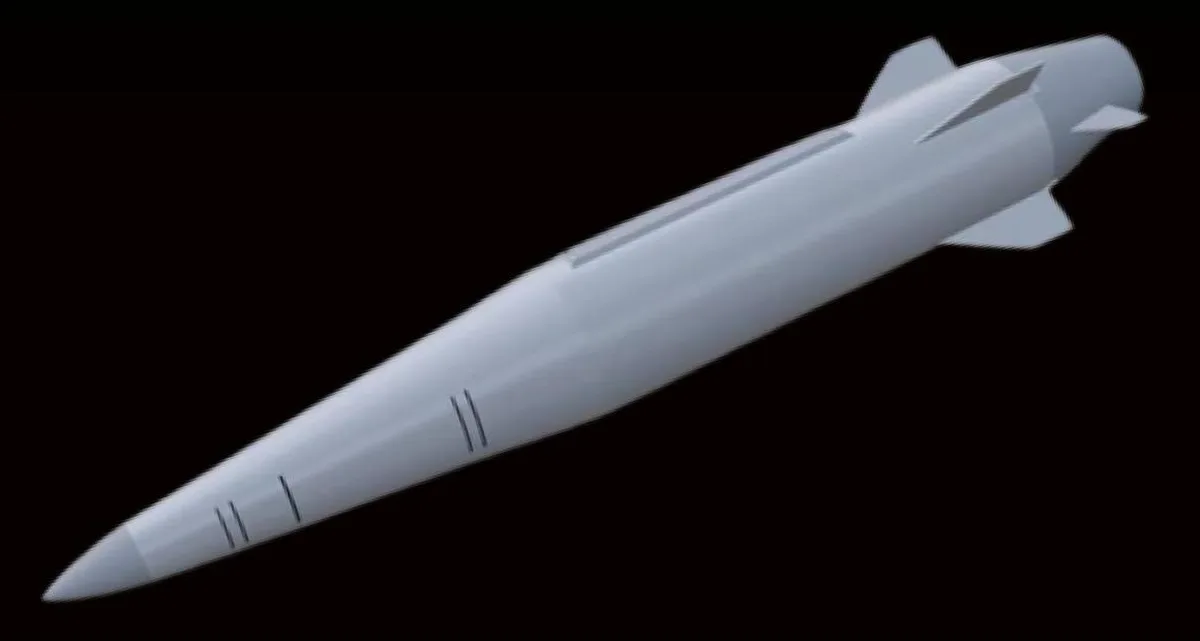
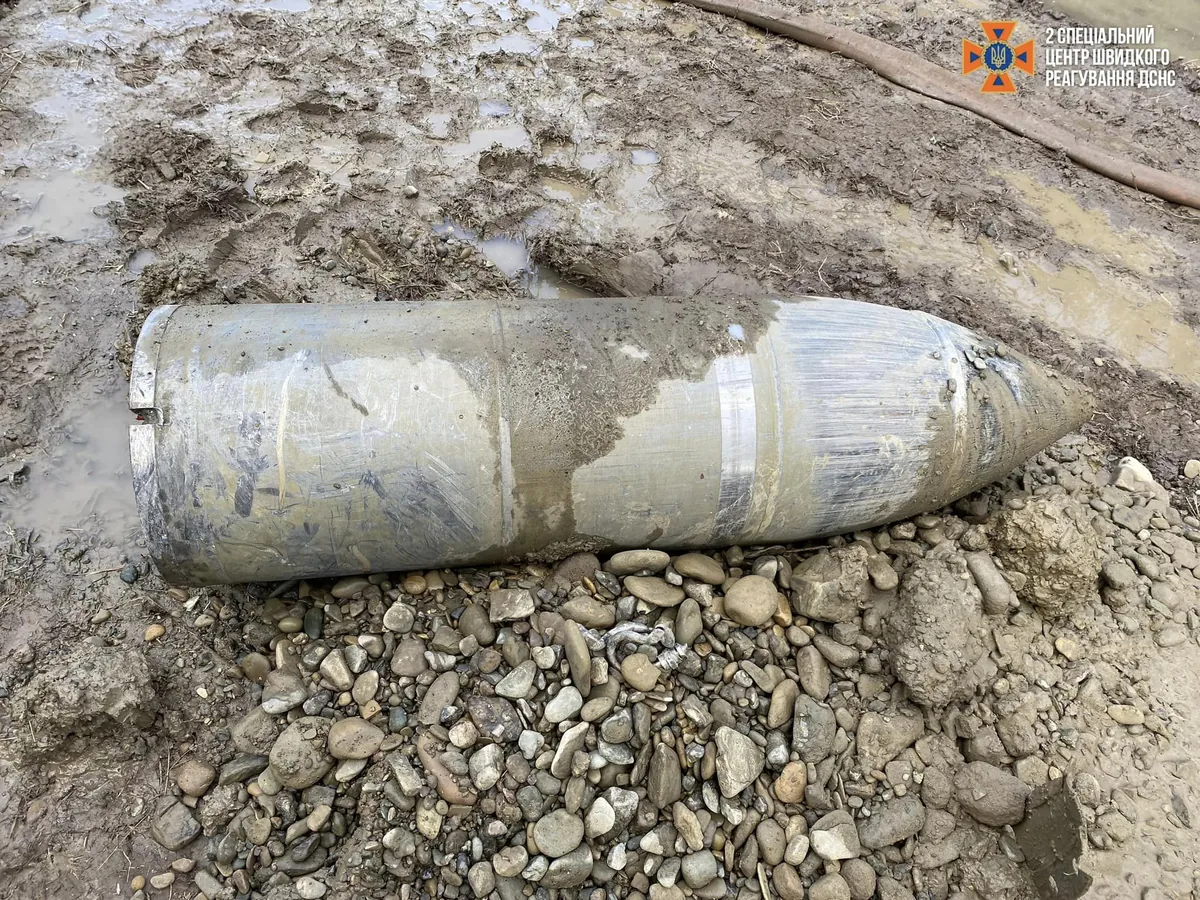
| Type | aeroballistic missile (air-launched ballistic missile) based on the 9M723 Iskander-M |
|---|---|
| Other names | Kh-47M2, Russian «Кинжал»; NATO reporting name AS-24 Killjoy |
| Carrier | MiG-31K fighter (one missile); no launches from Tu-22M3 against Ukraine have been recorded [2] [3] |
| Speed | claimed up to Mach 10; independent estimates about Mach 4 after launch [1] |
| Range | up to 1,000 km per Defence Intelligence [18]; Russia claims up to 2,000 km together with the carrier's radius [1] [3] |
| Warhead | 450 kg, penetrating high-explosive (or nuclear) per Defence Intelligence [18]; ~150 kg of explosive [3] |
| Weight and size | ~4,300 kg [1]; length 7,175 mm (8,000 with the tail fairing), diameter 920 mm [18] |
| Ceiling | up to 100 km [18] |
| Guidance | inertial with satellite-navigation correction and an active radar seeker, the U508 [18] [3] |
| Price | about $4.5 million according to documents obtained by Militarnyi; CSIS estimated up to $15 million [6] |
| First interception | night of 4 May 2023 over Kyiv Oblast, by a Patriot system [14] |
What it is made of, Defence Intelligence showed on 12 October 2026: an interactive 3D model, 197 components (most of them in the U508 seeker) and 58 cooperating enterprises — from the designer KBM and the Votkinsk plant to Radar MMS and the Polyus institute. Foreign parts come from ten countries: chips by Texas Instruments, Analog Devices, Micron, AMD, Altera (Intel), Marvell, Murata, Toshiba, and Belarus's Integral, manufactured in 2020–2022 [18]. That is the "import substitution" that failed [16].
Where Kinzhals are launched from
The Kinzhal's carriers, MiG-31Ks, are based at Savasleyka airfield in Nizhny Novgorod Oblast. Missiles have been launched from the airspace of Lipetsk (May 2026), Ryazan (March and June 2026) and Tambov oblasts (late 2025) [8]; on 11 February 2026 two Kinzhals were fired at Lviv in daytime [15]. On 15 August 2026 Ukraine struck Savasleyka; according to OSINT, some MiG-31Ks were then moved to Tatarstan [11].
The Kinzhal in 2026
- According to Defence Intelligence, Russia halted serial production of the Kinzhal and the Kh-32 in April 2026 — because of low accuracy (misses of 30 m and more) — and moved resources to the Iskander-M [5].
- By July Russia had about 50 Kinzhals left, according to intelligence [6]; their use in 2026 fell fourfold [7].
- The last launch in Air Force summaries was on 21 June 2026 (two missiles from Ryazan Oblast) [8]; the results for July–September list no Kinzhals destroyed [9].
- Alerts on MiG-31K take-offs continue even without launches: nationwide on 7 August and 17 September 2026 [10].
- The flight computer of a missile downed in May 2026 again contained American processors: replacing them with Russian ones failed [16].
Can the Kinzhal be shot down?
Yes. The first was downed on the night of 4 May 2023 over Kyiv Oblast by a Patriot system [14]. Since the full-scale invasion began, the Air Force has neutralised 91 Kh-47M2 missiles (as of 2 August 2026) [12]. The main tool is the Patriot, and the main constraint is the shortage of PAC-3 interceptors [13]. The makers of Ukraine's Lima electronic-warfare system claim to have pushed more than 60 Kinzhals off course; this has not been independently verified [17].
What the Kinzhal looks like on the map
A purple marker with a dot in the centre — "Kinzhal". Next to it, how many minutes are left until it arrives. Open the map · all threat types · Kalibr · Banderol
Sources
- CSIS Missile Threat — Kinzhal
- The Kyiv Independent — Russia's Kinzhal missile is not hypersonic, nor is it invincible
- Militarnyi — the Kinzhal: history and specifications (25.08.2025, in Ukrainian)
- Fakty — how long the Kinzhal flies: expert comment (17.09.2026, in Ukrainian)
- Militarnyi — Russia halts production of the Kinzhal and Kh-32 (10.08.2026, in Ukrainian)
- The Kyiv Independent — Russia has 50 Kinzhal missiles after pausing production (20.08.2026)
- UNIAN — how many Kinzhals Russia has and why it cut its strikes (16.07.2026, in Ukrainian)
- LB.ua — the attack of 21.06.2026: Kinzhals from Ryazan Oblast (in Ukrainian)
- LB.ua — what the Defence Forces destroyed in September 2026 (10.10.2026, in Ukrainian)
- NV — nationwide alert over a MiG-31K take-off (17.09.2026, in Ukrainian)
- United24 — Ukraine strikes the air base of the Kinzhal carriers (15.08.2026)
- ArmyInform — Air Force results over the years of the invasion (02.08.2026, in Ukrainian)
- ArmyInform — Kinzhal vs Patriot: an operator's account (03.09.2026, in Ukrainian)
- PBS — Ukraine says it downed a Kinzhal with a Patriot system (05.2023)
- Ukrinform — Lviv attacked with Kinzhals (11.02.2026, in Ukrainian)
- Militarnyi — failed import substitution in the Kinzhal (08.09.2026, in Ukrainian)
- Militarnyi — the Lima EW system and the Kinzhal (07.07.2026, in Ukrainian)
- Defence Intelligence of Ukraine, War & Sanctions — Kh-47M2 Kinzhal: specifications, 3D model, components and cooperating enterprises (12.10.2026)
The flight times in the table are an Alarm Maps calculation: straight-line distance divided by speed. How we compute the time to arrival on the map is described on the Sources page.
Updated .