Banderol (S8000): missile or drone?
The Banderol (S8000) is a small jet-powered cruise missile that Russia launches from Orion drones, helicopters and ground launchers. It flies at 520–560 km/h over 300–500 km and strikes mostly Odesa, Kharkiv and Kyiv. From Crimea to Odesa it takes about 36 min; over the sea it flies a few dozen metres up, so there may be no time left for an alert.
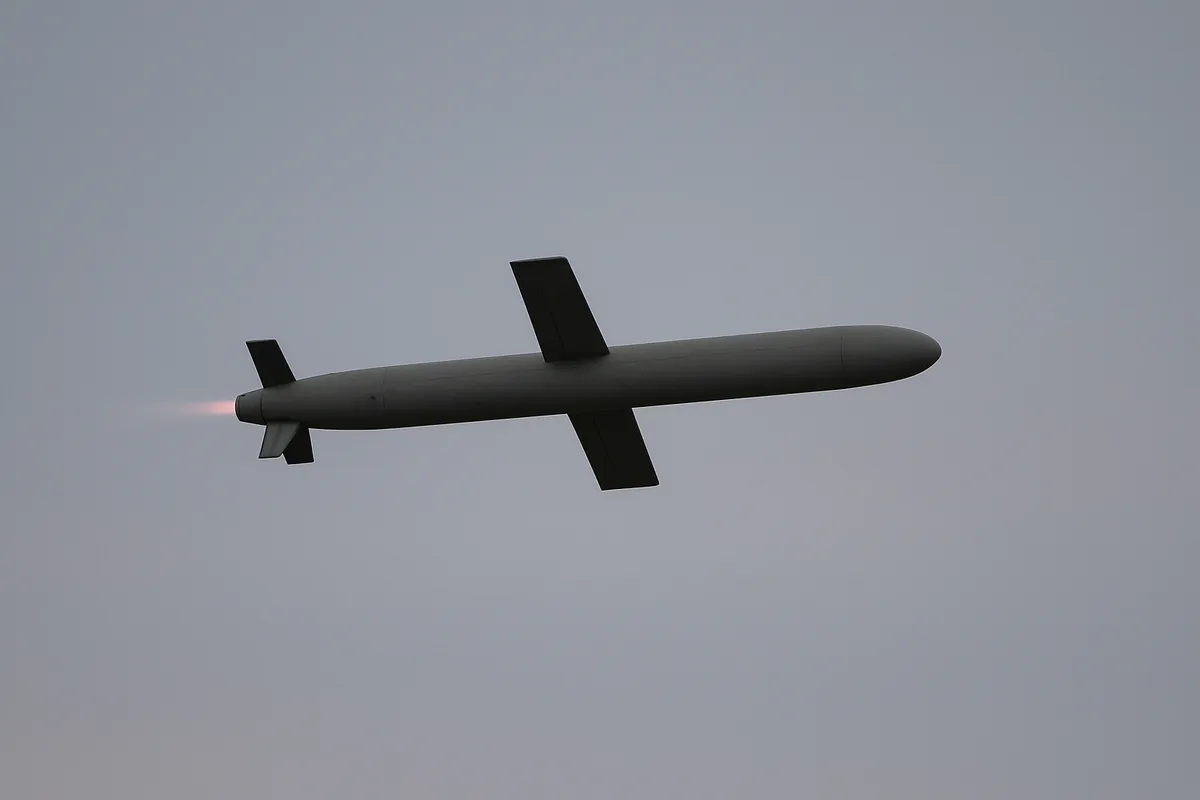
Is the Banderol a missile or a drone?
Both — hence the confusion. Ukraine's Defence Intelligence (HUR) classifies the S8000 as a small cruise missile [1]. The Air Force calls it a jet-powered loitering munition shaped like a cruise missile [5], and the media call it a "missile-drone". By design it is a missile: a jet engine, wings, a warhead and a pre-set route flown by satellite navigation. What it shares with drones is its carrier (it is launched from an Orion strike drone) and its low cost: the engine is a Chinese hobby-grade model sold online [2].
Banderol speed and range
According to HUR in 2025, the Banderol flew at about 500 km/h; 2026 examples are faster — 520–560 km/h cruise and up to 620–650 km/h top speed [2] [3]. On the map we compute the time to arrival with the average speed along the route — 450 km/h: the missile manoeuvres and rarely flies straight.
Range: up to 500 km according to HUR in 2025; in 2026 intelligence named 350–400 km, and 300–400 km for a ground or helicopter launch [1] [3]. Recorded strikes so far reach up to ~300 km from the launch site [11].
How long the Banderol takes to reach Odesa, Kharkiv, Dnipro and Kyiv
The times below are straight-line from the launch area to the city centre. They are a lower bound: the missile goes around air defence and changes course. But there is a flip side: over the sea towards Odesa it flies about 20 m up, and according to the spokesman of the Southern Defence Forces air defence has up to two minutes to react, and in the worst case about 30 seconds; the alert may sound after the strike [8].
| From | Kyiv | Kharkiv | Dnipro | Odesa | Lviv |
|---|---|---|---|---|---|
| Crimea (Saky) | — | — | 52 min 391 km | 36 min 271 km | — |
| Belgorod Oblast | 57 min 429 km | 9.6 min 72 km | 35 min 262 km | — | — |
| Kursk Oblast | 56 min 420 km | 26 min 193 km | 50 min 372 km | — | — |
| Bryansk Oblast | 54 min 408 km | 51 min 384 km | — | — | — |
| Sea of Azov | — | 55 min 411 km | 35 min 264 km | 59 min 443 km | — |
Launch areas are those named by the Air Force and the media in 2026. "—" means more than 500 km, the longest claimed range.
Banderol specifications
| Type | small turbojet cruise missile (HUR); "a loitering munition shaped like a cruise missile" (Air Force) |
|---|---|
| Other names | S8000 (Russian «Бандероль»), "missile-drone"; cheaper analogue — Dan-T [12] |
| Developer | Kronstadt JSC, produced in Dubna (Moscow Oblast) [2] |
| Carriers | Orion strike drone, Mi-28 helicopter (2–4 missiles per sortie), a pickup-based ground launcher [3] [4] [6] |
| Engine | Chinese hobby-grade turbojet Swiwin SW800Pro [1] [2] |
| Speed | 520–560 km/h cruise, 620–650 km/h top [2]; the same figures in the Defence Intelligence catalogue [15] |
| Range | up to 500 km; 300–400 km from the ground or a helicopter [1] [3]; Defence Intelligence — 500 km [15] |
| Warhead | high-explosive fragmentation, ~114 kg, of which ~50 kg explosive [2] |
| Size | length ~5 m, diameter 30 cm, wingspan 2.2 m [2] |
| Altitude | usually 400–2,000 m, ~200 m before the strike; about 20 m over the sea [8] [11] |
| Guidance | satellite navigation (GLONASS/GPS) and an inertial system; targets are fixed objects with known coordinates [2] [3] |
| Price | estimates range from $50,000 to $300,000 [2] [11] |
| Production | up to 80 missiles a month, according to HUR (August 2026) [13] |
| Fuel mass | 50–65 kg [15] |
Defence Intelligence's teardown found 24 components from seven countries in the Banderol — Australia, China, South Korea, Russia, the United States, Switzerland and Japan: a Swiwin SW800Pro-A95 engine, Dynamixel (Robotis) servos, RF Design telemetry, chips by Analog Devices, Texas Instruments, STMicroelectronics, Silicon Labs, InvenSense (TDK), Cypress (Infineon), Murata and Toshiba; the Kometa-M8 antenna is Russian, by VNIIR-Progress. The designer and main manufacturer is JSC Kronshtadt [15].
Where it is launched from and which cities it strikes
The main launch area is occupied Crimea; also Belgorod, Kursk and Bryansk oblasts and the Sea of Azov area [6]. On 22 September 2026 the Air Force reported 8 Banderols from Belgorod Oblast airspace — all shot down [14]. It most often strikes Odesa and the southern ports (in June–July 2026, about 80 % of attacks on Odesa's food infrastructure), Kharkiv and its oblast, and since June 2026 Kyiv; also Chernihiv, Dnipro, Zhytomyr, Sumy and Poltava [2] [11].
Can the Banderol be shot down?
Yes. It is downed by surface-to-air missile systems and tactical aircraft [5] — in October 2026 a French Mirage 2000-5F shot one down with its cannon for the first time [9] — as well as MANPADS and even an old Bofors L70 anti-aircraft gun. There is also a system from the Brave1 cluster whose interception costs less than the missile itself [10]. Fast FPV interceptors that work against Shaheds are ineffective against the Banderol [3]. According to the Air Force, 101 Banderols were destroyed in August 2026 and 86 in September [7].
Why "Banderol"
There is no official explanation. «Бандероль» means a small postal package. Since autumn 2026 the Air Force lists it together with its cheaper analogue: "Banderol/Dan-T" [12].
What the Banderol looks like on the map
A coral marker with straight wings and a cross-shaped tail — "Banderol". Next to it, how many minutes are left; the dashed line shows where it is heading. Open the map · all threat types · Kalibr · jet-powered Shahed
Sources
- Defence Intelligence of Ukraine — details of the new S8000 Banderol cruise missile (11.05.2025, in Ukrainian)
- Militarnyi — S8000 Banderol: a new Russian missile for strikes on Ukraine (21.08.2026, in Ukrainian)
- Militarnyi — HUR on serial production and new carriers (29.07.2026)
- Militarnyi — a ground-based launcher for the S8000 (28.07.2026)
- 24 Kanal — Banderol: specifications and how it is shot down (05.10.2026, in Ukrainian)
- LB.ua — hunting the Banderol: where it is launched from (17.09.2026, in Ukrainian)
- Interfax-Ukraine — Air Force results for September 2026 (10.10.2026)
- UNIAN — Banderol strikes on Odesa: why interception got harder (06.09.2026, in Ukrainian)
- UNIAN — a Mirage downs a Banderol for the first time (03.10.2026, in Ukrainian)
- ArmyInform — a Brave1 system is destroying Banderols (07.09.2026, in Ukrainian)
- The Kyiv Independent — cheaper than a missile, just as hard to down (12.08.2026)
- UNIAN — Dan-T, a cheaper replacement for the Banderol (28.08.2026, in Ukrainian)
- LB.ua — HUR: Russia can make up to 80 Banderols a month (12.08.2026, in Ukrainian)
- Ukrainian Air Force — summary for 22.09.2026 (Telegram, in Ukrainian)
- Defence Intelligence of Ukraine, War & Sanctions — S8000 Banderol cruise missile: specifications, components and manufacturers
Our figure — the 450 km/h the map uses for the time to arrival — comes from the Alarm Maps map; how we compute it is described on the Sources page.
Updated .